
Introduction
Cooking oils are one of the most basic essentials that can be found in each kitchen. They do not only give flavor to our food, but they also affect our health. Among all these cooking oils, two often popular ones shine out in Asian cuisines: mustard oil and refined mustard oil. Even though they both come from mustard seeds, their flavor, health benefits, and usage are considerably different. This guide will clarify the differences between the two oils so that you can choose the right oil for your cooking needs.
What is Mustard Oil?
Mustard oil is obtained from cold pressing of the mustard seeds. It can be described as having that deep golden color and a sharp, pungent smell. It would be one of the most savory oils used, for it forms part of India, Bangladesh, Nepal, and Pakistani traditional cooking. Besides their culinary use, there is always a great attachment to some health benefits as well as medicinal properties.
The key attributes of mustard oil are:
- Thick Aroma: The mustard oil has a powerful aroma that will give a rich flavor to dishes.
- Nuts are packed with monounsaturated fatty acids (MUFAs), omega-3 and omega-6 fatty acids, and antioxidants.
- High Smoke Point: Although not that high, it is moderately high and, therefore, pretty versatile in terms of usage, even up to some deep-frying.
What is Refined Mustard Oil?
It does not contain any impurities, hence is pale yellow in color, and does not have a sharp odor as well. The oil that can be obtained through refining is by heating and then passing through the filtration process; at times it also calls for chemicals for neutralizing purposes to extend its life period and enhance its taste. Refined mustard oil is used by those who want to enjoy the nutrients in mustard oil but don’t like the taste.
Important characteristics of refined mustard oil:
- Neutral Flavor: Being rather neutral, because of refinement this oil makes for a nice mustard in most dishes.
- Higher Smoke Point: The smoke point of the oil gets higher with refining. Hence, it is an excellent choice for frying and grilling at high temperatures.
- Longer Shelf Life: Refining improves the shelf life of oil, thereby discouraging rancidity from occurring.
Health Benefits of Mustard Oil
This health-rich oil has made it something more than a mere cooking medium. Let’s have a glance at why traditional mustard oil is considered healthier:
- Heart Health: Mustard oil is rich in monounsaturated and polyunsaturated fats, which help to reduce the level of bad cholesterol (LDL) and improve heart health.
- Anti-inflammatory and antimicrobial properties: Mustard oil contains allyl isothiocyanate, a natural compound with antibacterial and antifungal activity that may inhibit infection.
- It has rich antioxidants such as Vitamin E, which can reduce oxidative stress within the body and prevent chronic diseases.
- The other advantage of using mustard oil according to traditional practices is that it promotes skin and hair health, as the fatty acids and vitamin E in the mustard oil are good for them.
Health Aspects of Refined Mustard Oil
Even when refined, mustard oil with high heat tolerance will nonetheless lose several nutritional elements for its benefit:
- Nutrient Strip: Even refinement, which has the propensity of stripping out some necessary nutrients in cold pressed mustard oil, would often target antioxidants and omega fatty acids.
- Lower Antimicrobial Properties: The purification process removes or reduces the natural compounds such as allyl isothiocyanate, thereby reducing the antibacterial effects.
- Safe for High-Heat Cooking: It can be used safely at high heat since the smoke point has been enhanced, so it is a great oil for frying, grilling, and baking at a high temperature.
Mustard Oil vs. Refined Mustard Oil: A Side-by-Side Comparison
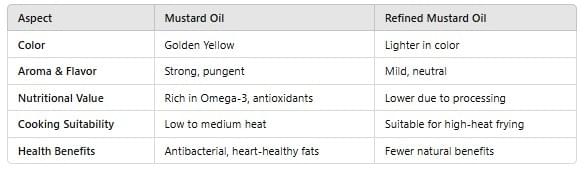
When to Use Mustard Oil vs. Refined Mustard Oil
- Flavor Preference: Mustard oil has a strong and pungent flavor, added to curries, stir-fries, and pickles. For people having a liking for strong-flavored dishes, the traditional variety of mustard oil is absolutely apt. However, it is refined mustard oil suitable for people who have preferences for mild tastes in foods.
- Health Considerations: If nutrient density is key, the unprocessed form of traditional mustard oil is the winner since it is higher in its natural antioxidants, omega-3 fatty acids, and health-benefiting compounds. While these will be lost in part to some degree in processing the oil into refined mustard oil, if you hate the taste or are doing very high-heat cooking, then the refined variety is probably your best choice.
- Cooking Methods: Traditional mustard oil is best used for sautéing, stir-frying, and low-heat cooking. For high-heat cooking such as frying or grilling, refined mustard oil would be a better choice since it has a higher smoke point, which would minimize the formation of unhealthy compounds.
Choosing the Right Oil for Your Kitchen
Thus, both types of mustard oils have their pros and cons. Therefore, your requirement determines the type of selection:
- For Health and Flavour: If you look for flavor and health advantages, then you need traditional mustard oil, especially while cooking at low to moderate heating.
- For Versatility and High-Heat Cooking: If one is seeking neutral flavor and high-heat cooking, then the more refined mustard oil will serve better.
Adding both of these oils to your kitchen may provide the best of both worlds. You may use traditional mustard oil in salad dressings, marinades, or low-heat recipes for their health benefits, and refined mustard oil when frying or for a more neutral taste when you prepare dishes.
Conclusion
The choice between mustard oil and refined mustard oil is based on your preference in cooking, health objectives, and flavor. Traditional mustard oil gives a richer nutrient profile and more intense flavor, whereas refined mustard oil provides a versatile, neutral option with a higher smoke point. Consider keeping both in your kitchen to enjoy the unique advantages.
If you are looking for premium quality mustard oils, browse through Gulab Oils‘ conventional and processed ones.
Contact us to learn more about the best cooking oils suited to your kitchen requirements!
Comments
Post a Comment